
The second state.
On the regime of Iyad Ag-Ghali.

To begin with, a distinction. Apparently on 30 October, the Wall Street Journal’s Benoit Faucon published an article in that American newspaper, entitled “Al Qaeda Is On The Brink Of Taking Over A Country.” This is not that kind of piece.
Jama‘at Nusrat al-Islam wal-Muslimin, or JNIM, has no chance of sacking Bamako, which it would need to do to take over Mali. Malian political scientist Boubacar Haidara offers a great review of the reasons this is impossible in an excellent article published at the Conversation.
What this post will do, following on my earlier post conceptualizing the zone of instability south of the Sahel as a “proto-state range,” is argue that JNIM is in several important ways already a kind of state, and that any attempt to address the situation its adversaries face must contend with that challenge. It will further look at certain developments more and less far from Mali, specifically in Nigeria and the Caribbean, in advance of setting off on the fool’s errand of considering what may happen in the future.
I. The view from Montevideo.
In 1933, when in Europe the international order was falling apart, in the Americas, several diplomatic delegations came together in Uruguay to settle on a definition of the state, which they did in the following terms:
The state as a person of international law should possess the following qualifications:
a. a permanent population;
b. a defined territory;
c. government; and
d. capacity to enter into relations with the other states.1
The Montevideo Convention went on to stipulate that of these, (d) was not a necessary condition of statehood. While only countries in the Americas are formally parties to the Montevideo Convention, in practice its definition largely superseded previous ones all around the world, though the unstated corollary that all territory outside Antarctica must always be part of some state has tended to use (b) to make (d) perhaps even more central to statehood than (a–c). That is, since all easily habitable earthly territory has definitively been claimed, only foreign recognition of a new community’s statehood, combined with recognition of the shrinking of another state’s territory, can permit that community truly to be considered a state.
It is in light of this last consideration, for instance, that Kenyan political economist Ken Opalo recommended in January 2025 that the United States and other countries use intentional delay of recognition of Somaliland’s statehood as an incentive aimed at getting Somaliland’s government to behave according to their will. Or, as British Foreign Minister David Lammy said in mid-2025 with regard to Palestine, recognition “is a card you can only play once.”2 Lammy might have added that it is a card that, under the current regime of international law, is held for the most part only by states that are themselves so recognized.3
For Morocco, it took thirty years and three last-minute phone calls4 from its king for the international community to formally agree to refer to Rabat’s suzerainty over the Western Sahara as a legitimate territorial claim, provided that the region enjoy autonomy.
Haidara, in the Conversation, notes that JNIM has never successfully occupied a regional or district capital in southwest Mali, a point that Mali watchers have been making among themselves for as long as JNIM has existed. This, combined with what might be called the “Montevideo Plus” bar for statehood as applied to cases like Morocco, Somaliland, and South Sudan means that that Journal article has more holes in it than Genevan cheese.
So why do I still “argue that JNIM is in several important ways already a kind of state”?
II. The play of states.
In just the second-ever post here at the Radical Cape Reading Room, I pointed to Max Weber’s definition of the state as “the human community that successfully claims the monopoly of the legitimate use of physical force within a given territory.” If the Montevideo Convention has given our contemporary world its juridical definition of statehood, Weber has provided its functional definition.
But, as I pointed out in our discussion of coups d’état, the ability to impose and maintain a monopoly of violence in a given geography is a very recent innovation, historically speaking. The idea that every inch of land on the earth is subject to one and only one monopoly-of-violence is barely a century old. But states have existed for thousands of years. And they have existed in a multitude of ways.
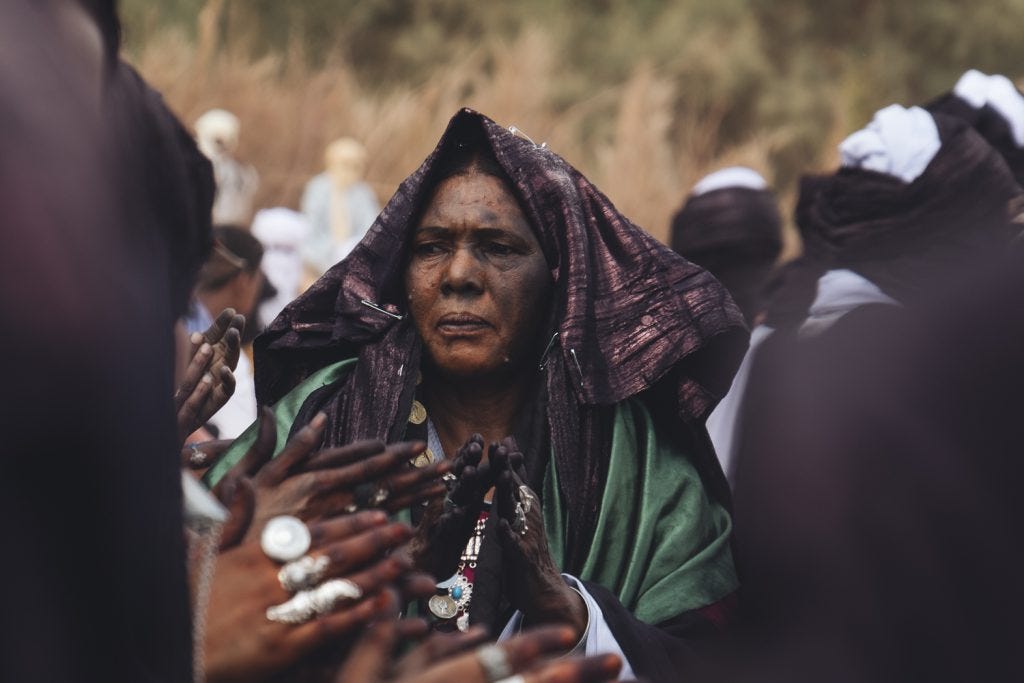
To take a few examples relevant to JNIM: Shaka’s early nineteenth-century Zulu Kingdom in what is now South Africa contained no urban settlements. At several points in British history (including at least two about which William Shakespeare wrote plays), the territory controlled by the king of England did not include the city of London, where the royal mint was located. And on every continent, there have existed feudal states, in which one person with the power to mobilize resources and exercise violence owes fealty to another whose claim is yet more expansive.5 Finally, as argued in my post on northwest Nigerian banditry, most of the area immediately south of the Sahel in West Africa is home to proto-states.
III. Today’s feudal state.
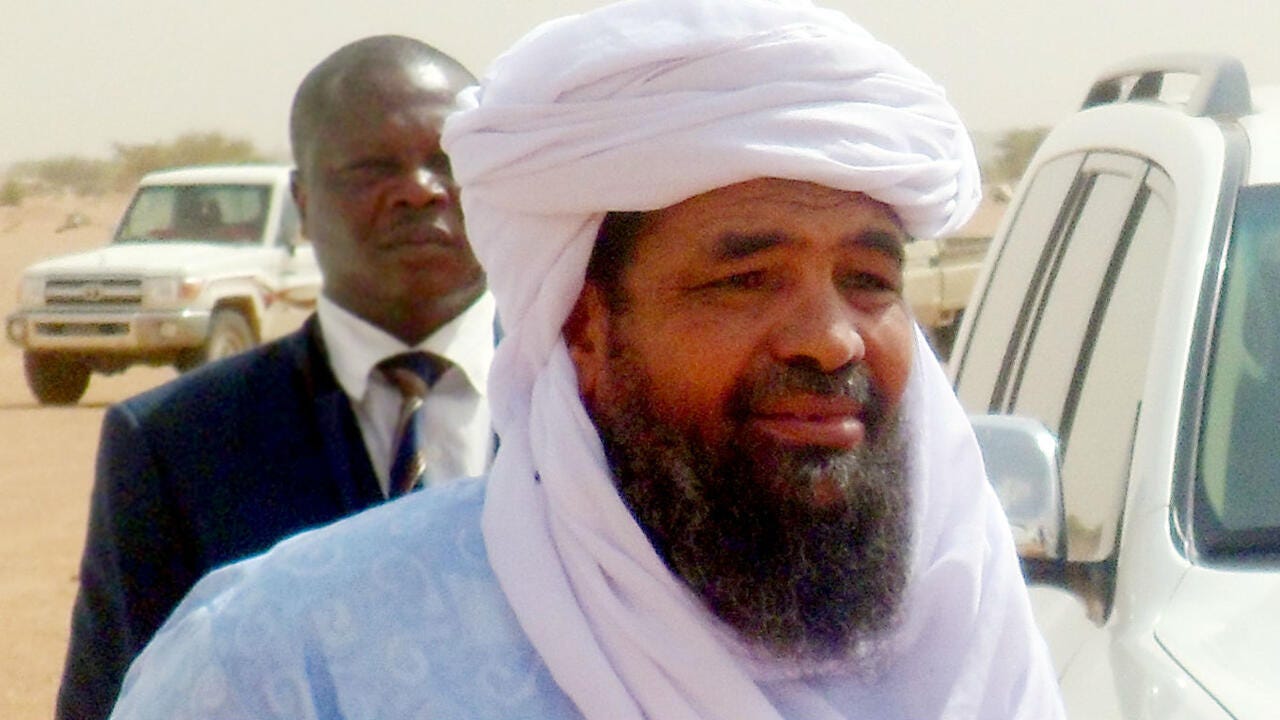
Iyad Ag-Ghali is a Tuareg veteran of several separatist movements focused on separating from Mali. During his youth in the twentieth century, he was a participant in secular separatist movements. Since 2012, Ag-Ghali has tended to claim religious inspiration for a series of armed movements that he launched. At first, these were terroristic, but they became increasingly insurrectional. JNIM, which he has led since 2017, is the latest iteration of these.
In classic feudal style, JNIM is formally associated with al-Qaeda, though there is little evidence of al-Qaeda currently governing JNIM. JNIM itself is not a monolith, but rather is a reinforcing hierarchical network of power, mobilization, and compulsion.6 Its territory is not limited to Mali, but rather, through these nesting relationships, extends through much of Burkina Faso and into parts of northern Ghana, Togo, Benin, and, most recently, Nigeria.
Even here, when experts speak of JNIM, they are usually intimately aware of the extent to which the acting entity of which they are speaking is under the full command and control of Ag-Ghali’s operation. Does central JNIM take credit for all that the entity does? Does it direct or approve of such activities? Are there notable social frictions along boundary points in the hierarchy? In a feudal state structure (as indeed is the case, if to a lesser extent, in a federal state structure, like that of Nigeria or the United States), a “no” answer to one of these questions does not necessarily invalidate the state’s stateliness.
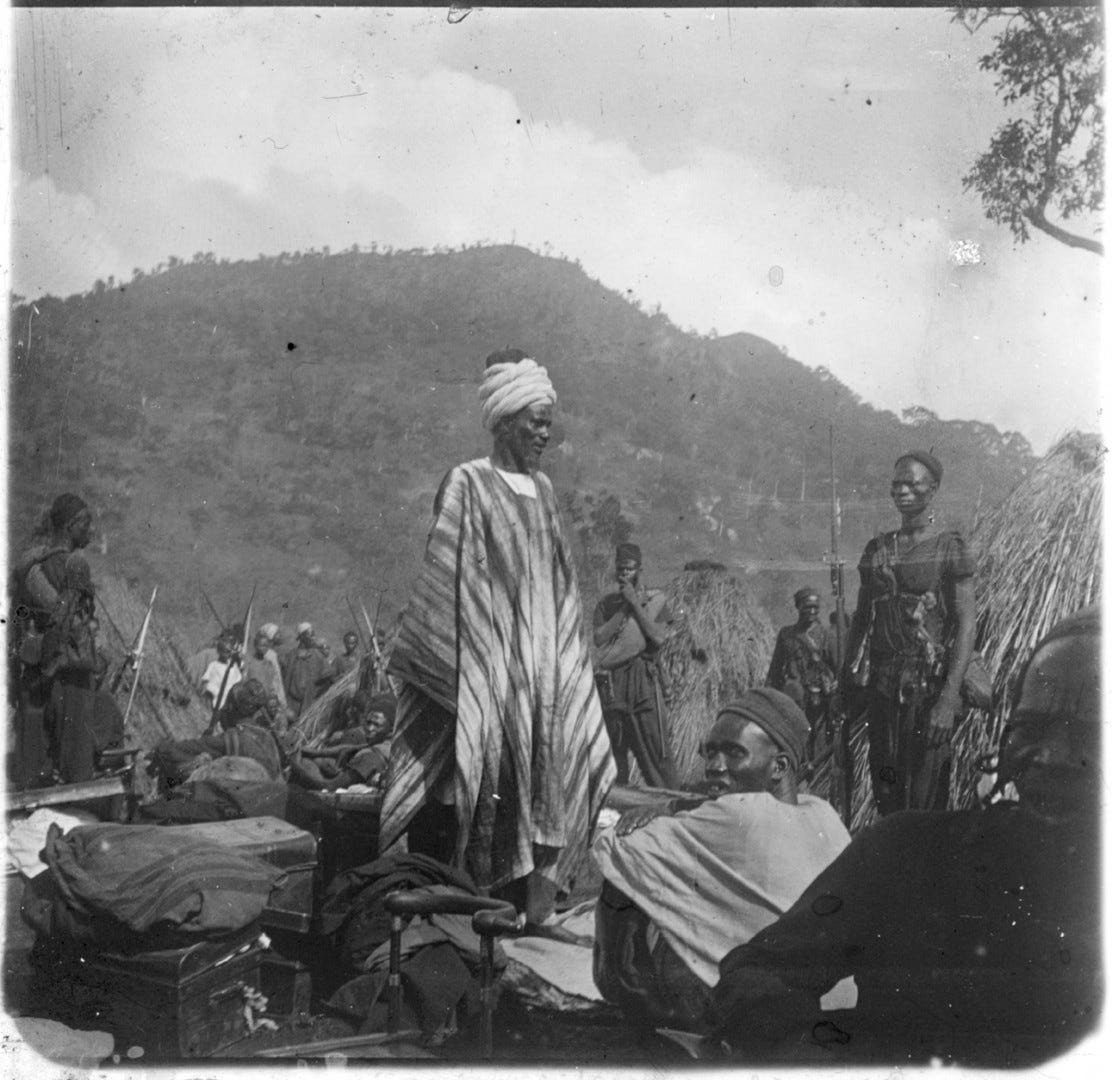
After Samori Touré established his Second Wassoulou Empire with the capture of Kong in what is now northern Côte d’Ivoire, he deliberately followed a strategy of avoiding other large settlements, especially any targeted by the British and the French, who were competing to enclose the region as part of the European “Scramble For Africa.” Of all the vassals over whom Touré might lose control, it ended up being his own son Sarankéni Mori, who bucked his father’s strategic plan by fighting both the British in Dokita and Wa (in present-day Burkina Faso and Ghana, respectively) and the French in Bouna (in Côte d’Ivoire).7 Touré’s inability to control his own son contributed significantly to the subsequent, and definitive, fall of Wassoulou.
Ag-Ghali has his own difficulties with his affiliates, though perhaps not on the same scale as Touré did. Ag-Ghali’s most widely reported frictions are in northern and eastern Burkina Faso. Outside of central and northern Mali, Ag-Ghali’s forces, while they can come quite close to cities and occasionally perform lightning strikes within them, do not attempt to occupy urban territory. Future JNIM attacks within cities, including Bamako, are certainly imaginable. These could be devastating. But future attempts by JNIM to govern large cities without fundamental changes both to JNIM and to its juridical-state opponents are unimaginable.
IV. Managing up.
The same week as a JNIM attack was reported in Nigeria and the Journal hyperventilated over its possible takeover of Mali, the American president claimed in a social media post that he was “hereby instructing our Department of War to prepare for possible action” in Nigeria. This was a swift escalation of a claim Donald Trump had made the day before that “Christianity is facing an existential threat in Nigeria.”8 James Barnett has a solid post over at the Hudson Institute on why the American president may be either referring to military contingency planning or setting up a negotiating tactic.9
Now, it goes without saying that the United States is not going to invade Nigeria, deploying the American military to the country in opposition to the desire of its government. But it is worth remembering what happened in relevant context sixteen years ago.

In 2009, Barack Obama took office as president of the United States. As the first president of African descent, it was reasonable to assume that he would take a particular interest in the continent. During his campaign, he had vowed to bring an end to the American war in Iraq. The American Department of Defense, ever skilled at managing up, succeeded in getting Obama to use prior congressional authorization focused on terrorist bases in Central Asia to authorize a level of active military deployment in Africa unprecedented since the end of the Second World War. Under Obama, for the first time since the founding of the Peace Corps during the presidency of John F. Kennedy in 1961, American military deployments on the continent came to outnumber American Peace Corps deployments. Obama ordered Africa’s first-ever combat drone strike. The American military, faced with a potentially declining role in national policy due to the Iraq drawdown, “managed up” and successfully used Obama’s unprecedented interest in the continent where his father was born and where his siblings lived to produce a crescendoing deployment of lethal force here.
Ok, but that was before. Now is rather different, isn’t it?
In December 2024, then-president-elect Donald Trump threatened to “take back” the Panama Canal, which is part of the sovereign territory of Panama. After taking office, he sent his secretary of defense to the country; the secretary of defense pointedly refused to acknowledge that the Panama Canal is indeed part of the sovereign territory of Panama.
Obviously, the United States never invaded Panama, just like it is not now going to invade Nigeria. But what is relevant to our consideration of JNIM is what has happened in Latin America since Trump expressed his interest.
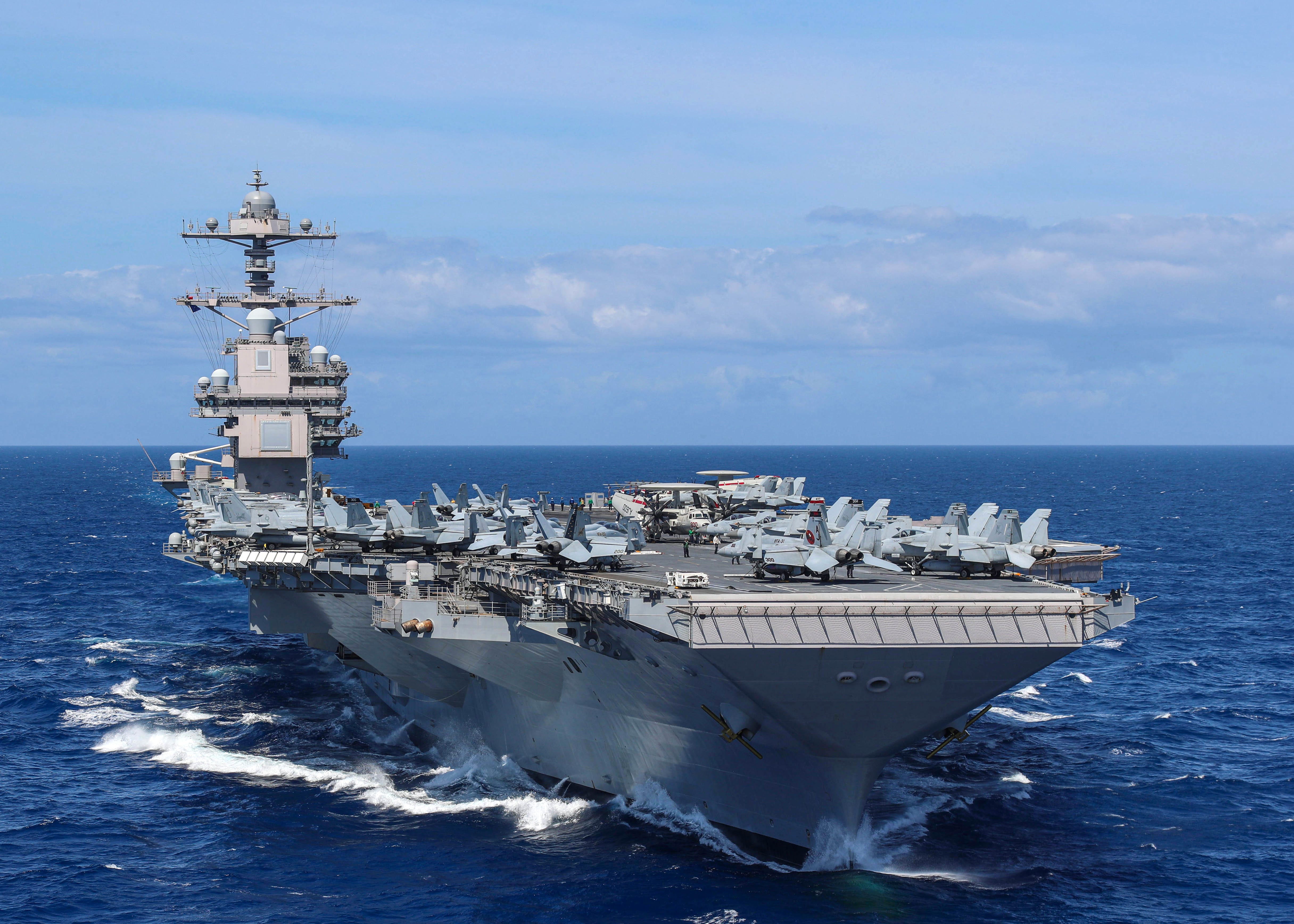
In September, October, and November 2025, the United States deployed more military and paramilitary resources to the Caribbean than at any point in time since the end of the Cold War. None of these are focused on invading Panama, which no serious person ever thought was a sane idea. Some may be threatening Venezuela. Some are blowing up private boats in the Caribbean and Pacific that parts of the American government suspect may be carrying drugs or other illegal cargo. Some of it is just because the United States is rich enough that if the president says he’s worried about events in a particular region, there are generals and admirals ready to offer to pass the most expensive military vehicle in human history through the neighborhood.10
V. Next steps.
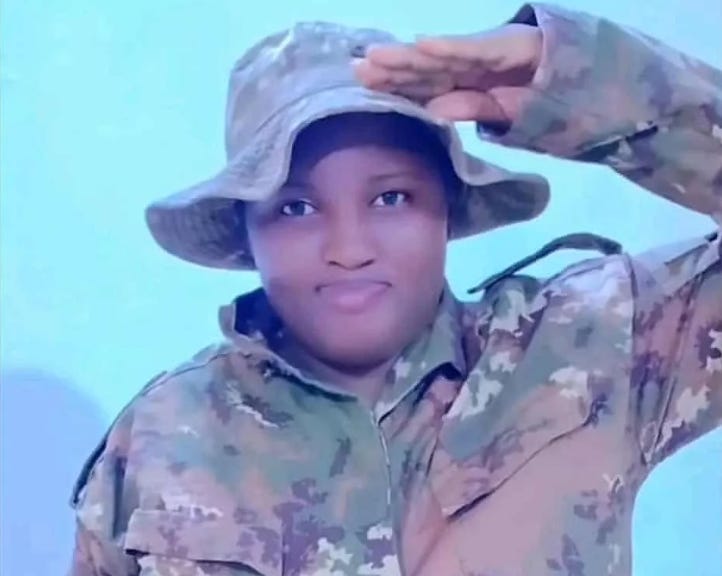
For a while, it looked like a negotiated settlement between JNIM and the Malian government was one of the most likely outcomes of the late 2025 JNIM blockade of Bamako. Then it was reported that Mariam Cissé, a young Malian woman who posted patriotic videos, among many others, to TikTok was publicly executed on 6 November by armed men understood to be associated with JNIM.11 Pressure on the Malian junta to negotiate with JNIM will likely decline as a result. As a downstream effect, a JNIM with no role in 21st century juridical state government will likely face less pressure to seek the consent of the governed than does the JNIM that currently exists: a perpetual mobile insurgency.
More likely than a negotiated settlement are two other possible near-term outcomes:
The United States, Italy, and their allies decide that Sahel in the 2020s is the heir to Afghanistan in the 1980s: a remote place to provide massive military and logistical support to committed anti-Western forces because those forces are fighting an enemy that was America’s most redoubtable foe a quarter-century prior—an enemy whose name-recognition is undiminished.12
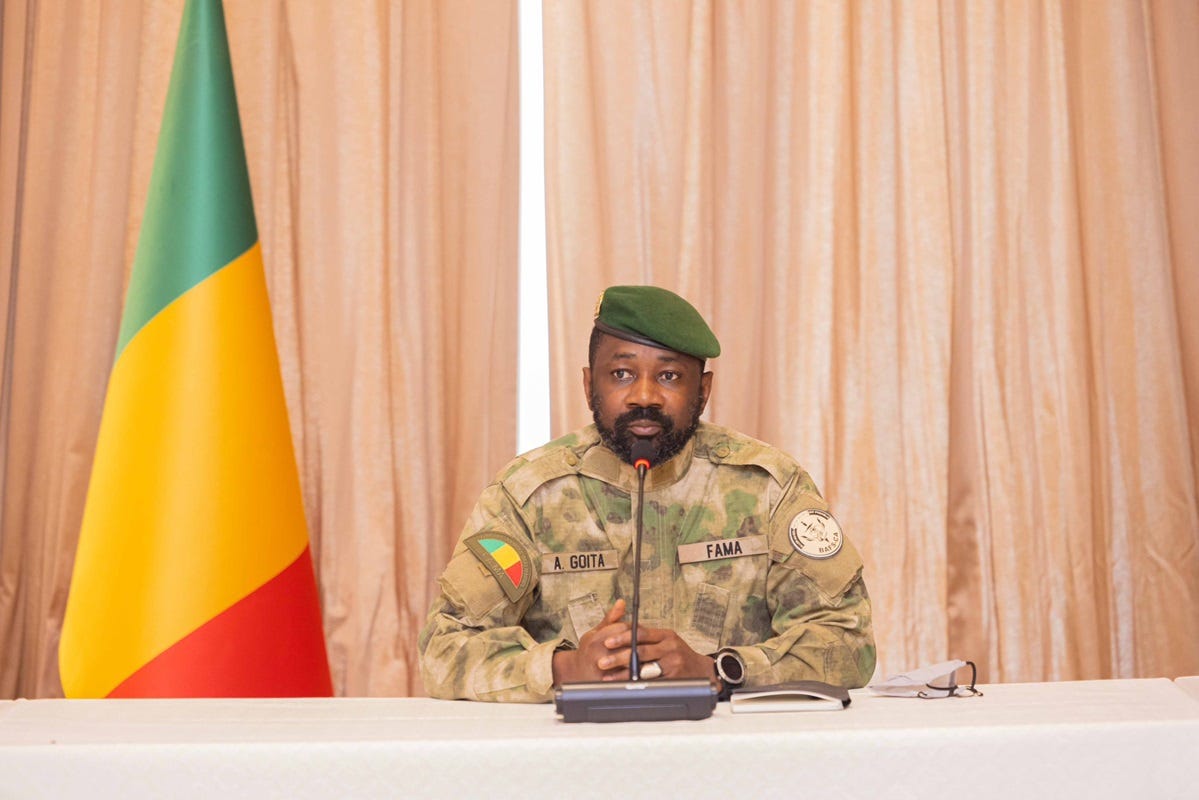
The Malian junta led by Assimi Goïta falls prey to a coup whose leaders are also inclined to oppose JNIM. This outcome is not incompatible with the one listed above.
Ultimately, Mali, its neighbors, and other interested parties should recognize that JNIM is indeed a de facto feudal state which, while incapable of doing many of the things that a contemporary juridical state can do, is nonetheless very capable of reproducing its own economy and power structure no matter which European country is allied to the Armed Forces of Mali.13
It means engaging with the idea that JNIM controls large swaths of rural Mali just as much as it needs to do to perpetuate itself, and there is no recipe containing special forces deployments and drone strikes that will dislodge from this feudal state the economic and social forces that drive it. Ag-Ghali’s capacity to be patient with the status quo is likely greater than Goïta’s; a purely rural and mobile feudal state is far less expensive to run than is a Montevidean nation-state.
Regional banks are starting to signal a willingness to limit their operations in-country,14 suggesting that Ag-Ghali could add the breaking straw to the camel’s back after the long efforts of regional and global democracies to force Mali’s current government to transition to another one. The story will likely continue long from here.
I have seen renderings of this same text with identical wording but slightly different layout and punctuation. The differences in question are not portentous of different meanings.
The U.K. formally recognized Palestinian statehood in September of the same year.
Even here, though, recognition is not necessary a binary matter. Uganda reportedly accepts passports issued by M23, a separatist militia in the eastern Democratic Republic of Congo whose territorial control has never received formal recognition by any state, including Rwanda, which provides M23 with operational support. Kenya reportedly provides consular services in M23 territory.
In How Europe Underdeveloped Africa, Walter Rodney argued that feudal structure defined the paradigmatic precolonial state in Africa (Rodney [1972]/2005, pp. 37, 44). Rodney’s analysis is rather indebted to Marxist phenomenology, whereas the argument employed in this post focuses more on command and control structures. At the same time, this argument would profit from Rodney’s insistence that conclusions and beliefs drawn from European and other non-African experiences of feudalism are largely irrelevant to considerations of African feudalism, and should be bracketed (p. 43).
This is a matter of common knowledge to experts in the field, which can be seen at least glimpsingly in their reports and articles.
(Kambou-Ferrand 1993, pp. 231, 242) Mori was reportedly in command of a pro-war contingent of Touré’s forces.
The quotes selected here make Trump’s rhetoric sound more controlled and considered than full context would allow it to be.
For two different but excellent emic perspectives: Chris O. Ogunmodede writes at Penkelemesi why many Nigerian Christians, while disagreeing with Trump more broadly, do nonetheless feel targeted as a community by insurgent violence; Elnathan John offers an extended, meticulous meditation on the history and domestic sociology of the conflict. Insofar as their posts may have any weakness at all, it would be tightly bound up with their exquisite strength: that they treat the relationship between insurgents, governments, and citizens in and around the savannah belt as an exclusively Nigerian matter, with causative engines wholly contained in domestic Nigerian history.
I am not making any claim as to the worthiness, responsibility, legality, or moral excusability that any of these activities have in and of themselves. I am merely saying that they are all at least a little less cockamamie than the United States invading Panama to take control of the canal there. They are cases of the military and intelligence community managing up in response to the known interests of a sitting American president. This is what the same military and intelligence establishment did in the context of Barack Obama’s very different interest in Africa broadly speaking between 2009 and 2017, and what they might conceivably do in the sub-Sahelian region or elsewhere on the continent in or after 2026, given Trump’s claims about Nigeria, as well as earlier claims he has made about South Africa.
While it is most likely that the execution was performed by JNIM, they had not claimed credit for it as of 14 November, though multiple reasons may explain this. Both JNIM and the Russian allies of the Malian government have repeatedly impersonated their enemies while terrorizing civilians. In any event, fundamentally, the fact that November 2025 might be the most self-defeating time in its history that JNIM could publicly carry out an execution like this one in no way means that it did not do so. A tragically persistent feature of regional insurgencies has been brutal violence that only serves to extend the conflict.
Lesley Anne Warner discusses the context and some potential effects of this approach in an article at the World Politics Review.
Recognizing that JNIM is a de facto feudal state is not the same as providing diplomatic recognition of JNIM as a state. I recommend the first as an activity which is conducive to clearly thinking through the situation. I do not in any way recommend the latter.