
The Russian ribbon.
The power of a military cordon after Caracas and Tehran.

To get to the African part of this story, we will start with two paragraphs in Syria.
I. Flights from Lakatia.
In January 2011, Bashar Assad, the second-generation Syrian dictator, gave an interview to the Wall Street Journal, an American newspaper,1 speaking positively of the “new era” of rights and governance that the Arab Spring was ushering in, and explaining why his own regime was sufficiently enlightened as not to be at risk, notwithstanding public demonstrations that had already begun by the date of publication. Within two months, the Arab Spring had fully reached Syria.
Assad’s reaction was increasingly sanguinary, and Syria was riven by civil war in mid-2012. Russia, whose military had arrangements with the Assad regime for the use of the country’s seaports, aggressively backed Assad right up to his flight from the country on 8 December 2024, when, having surreptitiously taken a Syrian Air cargo jet to the Russian-controlled seaport of Lakatia, thence fled directly to Moscow on a Russian military transport. There, Assad was given asylum.
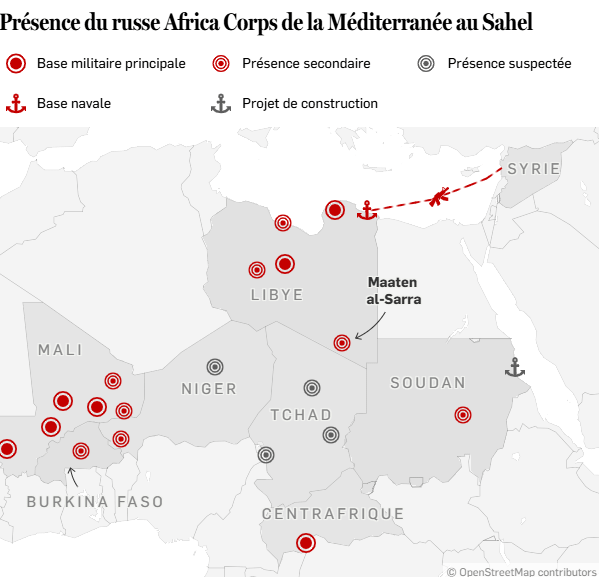
No longer having an allied host government in Syria, Russia evacuated much of its Lakatia materiel to Libya, another country where it had staunch allies fighting a civil war. Here, too, Russia’s allies, with its logistical and material support, maintained a moderately stable foothold along the coast which enabled the Russians to keep a Mediterranean port, this one in Tobruk in Libya’s east.
II. Libya and the American model.
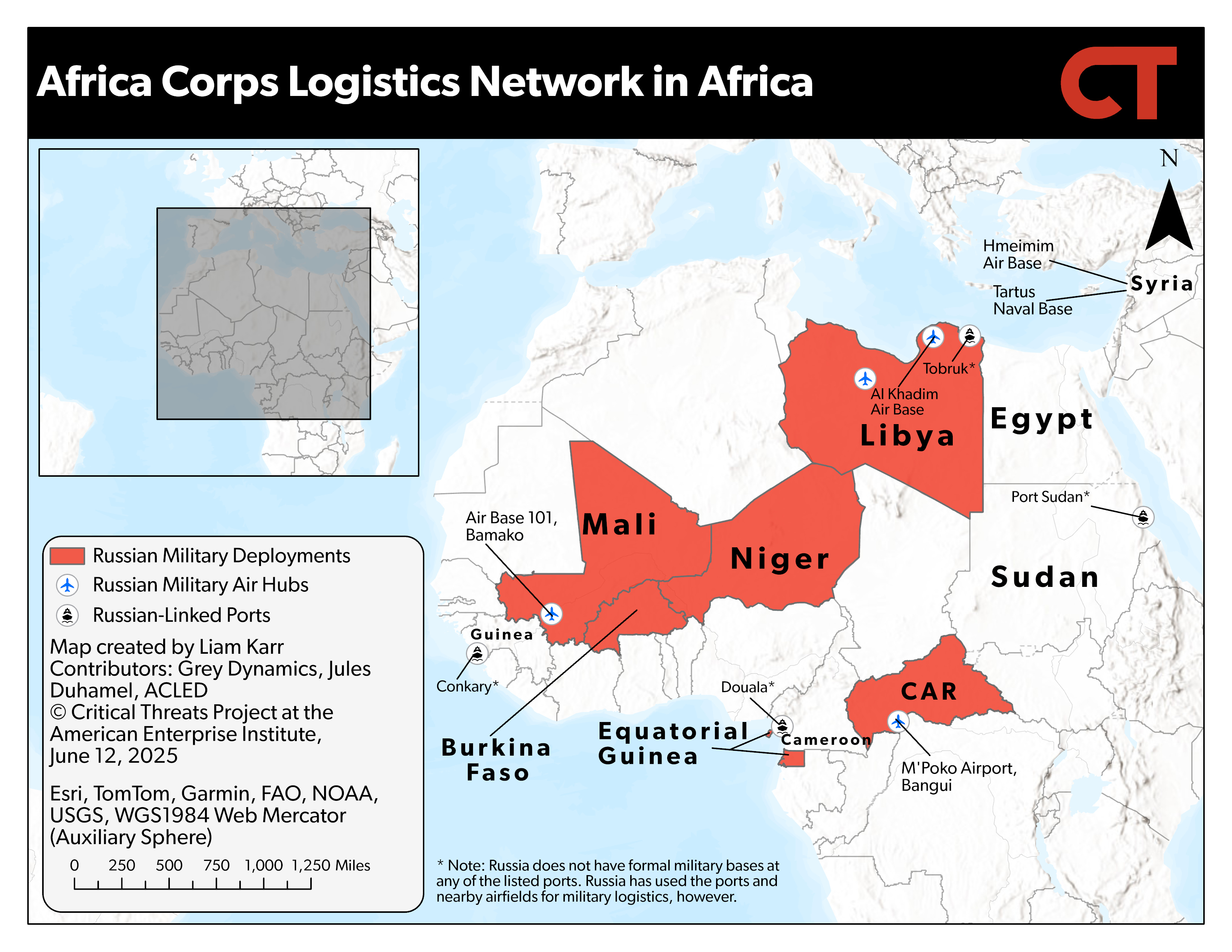
In February 2025, journalist Matteo Maillard published a superlative study in Jeune Afrique that looked at Tobruk in the context of broader Russian military deployments around Libya, across the Sahara and Sahel, and down into the savannah belt, as far west as Bamako and potentially as far east as Port Sudan.2 The southernmost Russian base was in Bangui in the Central African Republic, deep into the central African forest belt.3
Maillard reported:
“The Russians are looking to deploy a presence modelled after that of AFRICOM, the United States’ unified command for Africa that coordinates all the American military and security activities on the continent,” said a Malian researcher. Beyond the Mediterranean–Sahel link, the next objective of this reorganization of the Russian footprint in Africa would be to block Western powers’4 [aerial] route to the South Atlantic, by jostling the coastal countries of the Gulf of Guinea against this new Muscovite playground.5
Russia’s move had been in preparation for several years at this point, as it developed relationships with actors in civil wars and military juntas in Sudan, Chad, Niger, Burkina Faso, and Mali.
In 1988, terrorists organized by Libyan intelligence services bombed Pan Am Flight 103 over Lockerbie, Scotland; in 2014, Russian-backed separatists shot down Malaysia Airlines Flight 17 in Ukraine. Given these previous attacks on civilian passenger aviation, at least at a conceptual level, the challenge posed by the Russian network of bases across the Sahara and desert-side geographies might have seemed to be significant.
III. The quiet Americans.
Notwithstanding the seeming threat, the American and European response in 2025 was surprisingly muted.
The idea that Russia actually had an uninterrupted cordon of bases in mid-2025 was not uniformly accepted. Though the Americans had been driven out of the drone base they had built in Agadez, Niger, now a country firmly aligned with Russia, in June of that year, the American Enterprise Institute’s Critical Threats Project, using data from ACLED and other sources, published a map on which the Russians are shown as having no “air hubs” in Niger. CTP also recorded no Russian deployments at all in Chad, from which the United States had been asked to leave by the government in April 2024.6 Similarly, a group of analysts at the Combating Terrorism Center at West Point, an American military academy, saw only a minimal threat to American interests in the region posed by these underpowered Russian forces. The same analysts did note that an increasing number of former American allies were now welcoming Russian troop deployments.
In December 2025, security analyst Frank Talbot published a short piece with the Atlantic Council, arguing that Maaten al-Sarra, the southern Libyan base whose construction had been the linchpin in Jeune Afrique’s analysis, was “Russia’s new strategic platform” and its “most important Middle East base.”
Overall, the intellectual apparatus affiliated with the American national security establishment was equivocal, yet largely patient, with regard to the growing Russian footprint in North and West Africa.
On the one hand, it made sense to assume that, as long as the Russians could secure their anti-aircraft materiel against raids from increasingly robust regional insurgencies, neither they nor their African allies would likely deploy it against civilian targets: Russia had less reason to risk seeming to support attacks on civilian aircraft in Africa than it had in Ukraine. On the other hand, it would eventually become clear to all observers just how confident the United States military was in the technical supremacy of its own aerial attack capacity, to the point of not much worrying who else deployed what tech where.
IV. American activism; local non-alignment.
In January 2026, the United States executed a decapitation strike against Venezuela. In preparation for kidnapping Venezuela’s head of state, the American military rapidly disabled the country’s anti-aircraft defenses.
The following month, the United States assassinated Iranian supreme leader Ali Khamenei and a large swath of the country’s leadership, including both hawks and moderates. While using different modalities in Iran than in Venezuela, the United States once again demonstrated that its military’s capacity to launch surprise extra-legal decapitation strikes is unconstrained either by its own legal system or the aerial defenses of its targets.7
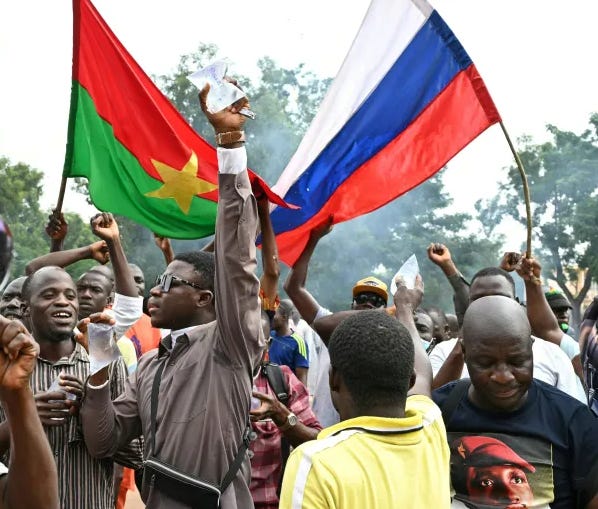
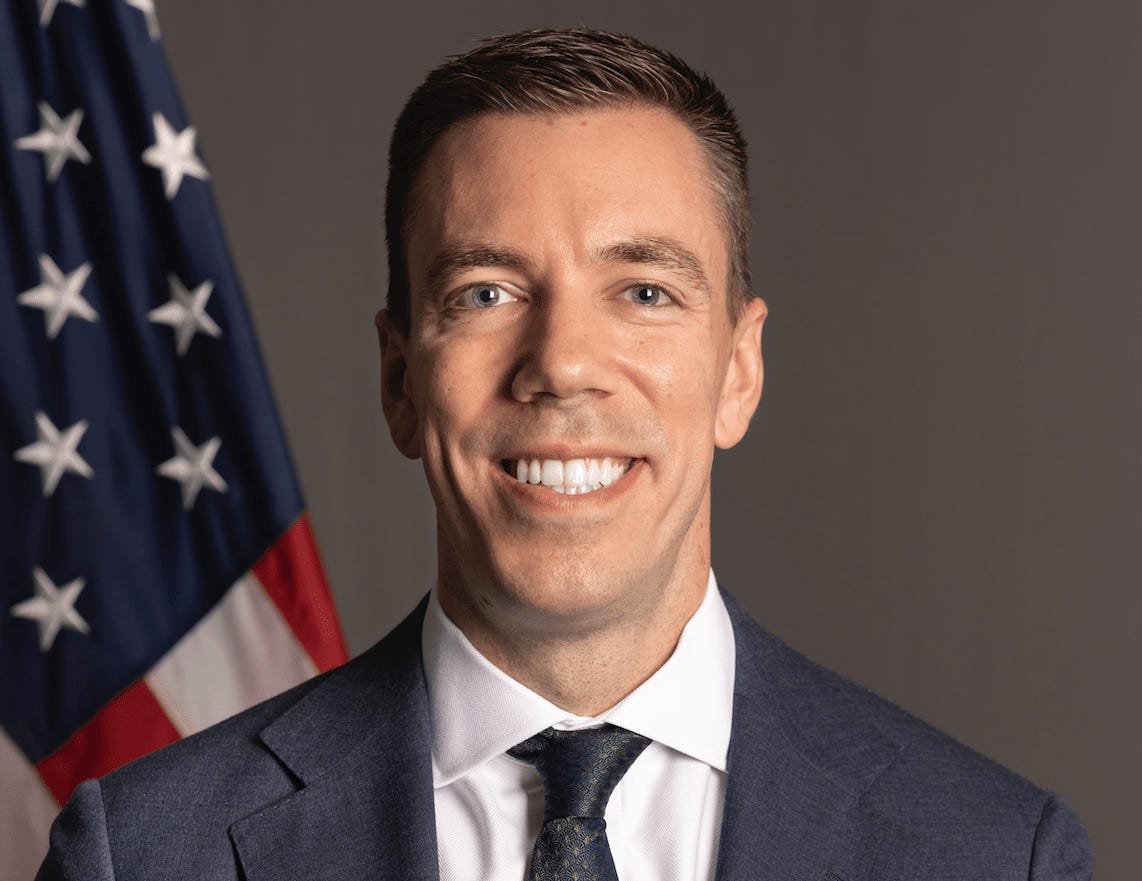
In February and March of 2026, the governments of Mali, Burkina Faso, and Niger, which had up to very recently been characterized as “anti-Western,” welcomed Nick Checker, an American former intelligence analyst working as a political appointee American State Department8 as Checker made a lightning tour of the region, re-opening intelligence sharing agreements and military and intelligence overflight arrangements that had been suspended in the wake of the three countries’ coups.9 Mali had been faced with a civilian opposition showing more vigor than at any point since the installation of the current regime, while Niger’s government envisioned the hands of Benin, Côte d’Ivoire, and France behind every demonstration of its own failure to fulfil its promise of improved domestic security.
None of the three countries’ nominally transitional governments had distanced themselves from Russia, but all seemed willing to re-engage the United States if so doing can keep them off a target list they may or may not have ever been on, and can perhaps forestall any growing domestic pressure they may feel to transition to democracy (or to a differently inclined junta).
In a future post here at the Radical Cape Reading Room, we’ll look at how Sékou Touré balanced relations with Guinea-Conakry’s neighbors and with France, the Soviet Union, and the United States between 1960 and 1984. It is a path we may see other African heads of state tread in our own times.
I still have several weeks of reading to finalize that post, and other topics will come to the fore in the interim. Longtime subscribers will recognize that geopolitics is only one of the topics we cover here, though understandings of each topic tend to be mutually enriching as time goes on. Unfortunately, we live in an age when geopolitics repeatedly force themselves into focus whether or not we enjoy the view they offer.
For reasons of concision, we can largely pass over the distinction between the Wagner Group, the Russian paramilitary outfit that launched most of these deployments, and the Russian Africa Corps, which succeeded Wagner after a mutiny everywhere but in CAR, which was nonetheless affected by Wagner’s forced reorganization after its leadership and some of its European units mutinied against the Russian government. Likewise, since our focus here is largely on the western Sahel and savannah belt, we will not be looking at the evolution of Russian engagement in Chad and Sudan since early 2025.
This may be better understood as “Western European powers”
(my translation)
CTP republished the map in March 2026.
Iran subsequently demonstrated that its own armed forces could force a shutdown of civilian traffic through the Strait of Hormuz, a retaliation costly to the global economy whose predictability nonetheless had had no deterrent effect on the American strikes.
The title of the role performed by Checker is Assistant Secretary of State for African Affairs. The second administration of American president Donald Trump has declined to nominate anyone to fill this role, and has instead staffed it with a succession of temporary appointments, of whom Checker, who had in 2025 served on the American National Security Council, became the third in less than a year.
Checker’s visit to Mali, whose regime has imprisoned the French embassy’s registered intelligence officer, preceded the American attack on Iran. He thence returned to the United States, and his visits to Burkina Faso and Niger followed the first American strikes on Tehran. All three African countries had long since closed their borders to American civilians in retaliation for American travel policy, which closed U.S. borders to most travellers from over a dozen African countries, Burkinabés, Malians, and Nigeriens included. The nominal reason for the proposed increased multiplatform intelligence exchange was an American desire to secure the release of an American missionary kidnapped in Niamey by insurgents in October 2025; the American was presumed to be held in Mali.